Through a Baby's Eyes: How Infants See Art, Colour and Complexity
by Grace McKinstry and Alli Mitchell

Is that baby book you think is adorable really what your child likes?
Is your infant as crazy about those new crib sheets that you just bought as you are?
We rarely think about infant perception. A baby in a museum is usually greeted with polite
smiles but otherwise little consideration—what could a four-month-old possibly get out of an art
gallery?
According to Professor Anna Franklin, quite a lot.
Infants are far more than passive observers; they are busy, perceptive, and surprisingly
sophisticated viewers. Whether staring at a swirling Van Gogh sky or the ornate ceiling of the
Royal Pavilion, babies’ eyes lock onto colours, contrasts, patterns, and edges in ways that reveal
the earliest foundations of our visual experiences and preferences.
At the University of Sussex, Franklin leads the Sussex Colour Group and co-directs both the
Sussex Baby Lab and the Centre for Sensory and Perceptual Diversity. Much of her research sits
within the field of aesthetic science, a field that explores why certain sights feel pleasing or
interesting and how sensation, emotion, and meaning come together to create what researchers
call an “aesthetic experience” (Chatterjee & Vartanian, 2014).
Adults bring decades of learning, culture, and memories into their aesthetic judgments, while
infants, on the other hand, do not. This is precisely what makes them scientifically valuable, as
they offer insight into our earliest, most unfiltered visual preferences before experiences and
knowledge begin to shape them.

What Babies Actually See
To make sense of these preferences, it helps to understand what infants are actually able to see.
By around four months, infants already have functional colour vision. Their acuity is not yet adult-like, but the basic ability to distinguish hue is in place (Teller et al., 1978; Teller, 1998). Even at this early stage, infants can show visual preferences—for example, they tend to look longer at blues than at yellow-greens (Skelton & Franklin, 2020). By this age, babies can also detect depth, track moving objects, and recognise simple patterns, giving them the basic senses needed to meaningfully engage with artwork (Shuwairi et al., 2010).
How Babies Tell Us What They Like
To decode infant perception, Franklin, Dr. Alice Skelton and the Sussex Baby Lab team rely on infant eye-tracking, a method that records where and for how long babies look at different parts of an image. Because infants can’t point, choose, or describe anything, the amount of time they spend looking becomes a reliable indicator of what the visual system finds interesting or informative. Tiny shifts of gaze, quick returns to a specific area, or longer pauses on certain features all reveal what captures their attention (Franklin et al., 2005).
These methods have enabled a wide range of creative research contexts. One example is the Baby Art Gallery, curated for the British Science Festival, where artworks were overlaid with infant eye-tracking heat maps so visitors could literally see which parts of each piece babies found most captivating (Franklin & Skelton, 2024). This gallery offered one of the first public windows into how infants visually explore art.
Fig. 3 Heat-map eye-tracking images from the Baby Pavilion project. Images via Brighton & Hove Museums (2024). The red clusters indicate where infants fixated most intensely, while the green areas show lighter, more diffuse attention.
Dr. Philip McAdams, working with Franklin and Skelton for his PhD, used similar approaches in an experimental study in which babies viewed 40 paired Van Gogh landscapes while wearing eye trackers. Fascinatingly, infants tended to look longer at the same landscapes that adults consistently judge as more aesthetically pleasing, suggesting that some aspects of aesthetic preference may emerge from early sensory biases rather than solely through culture and acquired knowledge (McAdams et al., 2025).

A related project is the Baby Colour Trail at Brighton’s Royal Pavilion. Inspired by the Pavilion’s lavish interiors, the Sussex Baby Lab worked with the museum to create a route highlighting the architectural details that align with what infants naturally find stimulating. The trail is designed not only to enrich infants’ viewing experiences but also to support caregivers, offering a structured way for families to explore cultural spaces together (Brighton & Hove Museums, 2024).
Fig. 5 Babies exploring the Royal Pavilion during the Baby Colour Trail. Images via Brighton & Hove Museums (2024).
Why Babies Prefer Complexity
A major theme in the Sussex Baby Lab’s work is that infants prefer complexity, not simplicity. This may be counterintuitive, especially if you’re familiar with theories like Perceptual Processing Theory (Reber et al., 2004), which suggests people prefer stimuli that are easier to process. But infants don’t yet have the experience that makes “ease” enjoyable. Instead, Sussex Baby Lab studies show that infants look longer at images with richer edges, more curves, and more varied orientations (McAdams et al., 2025).
This preference fits with broader findings that infants are drawn to more complex stimulation even across sensory domains. In hearing, for instance, newborns respond more intensely to complex sounds than to simple tones, suggesting that complexity offers more information for a developing sensory system to work with (Bench & Mentz, 1975).
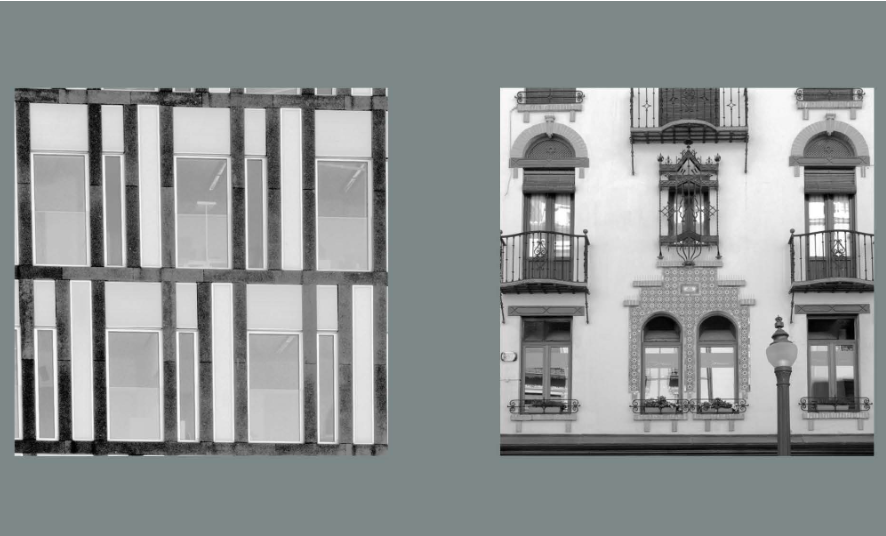
This helps explain why babies tend to prefer ornate, highly decorated façades over minimalist ones, why they prefer urban scenes over nature scenes, and why they sometimes prefer images that adults find odd or unappealing (McAdams et al., 2025). Adults bring memory, emotion, and meaning to their judgments while infants simply go for what is visually abundant.
From Research to Real-World
These insights have led Franklin, Skelton, and McAdams beyond academia and into creative collaboration. In partnership with artist Camille Walala and the company Etta Loves, they contributed to the development of patterns informed by infant sensory data, which Etta Loves then used to design muslins and other patterned baby products. The Baby Lab also collaborated with educational publisher Twinkl to create sensory cards for babies featuring the kinds of complex buildings and high-contrast patterns infants prefer. Franklin has authored baby books and even helped design a baby sensory film, which has reached over 130K views on YouTube.

Together, these projects illustrate how understanding infant perception can inform design, education, and everyday caregiving. Understanding what captures a baby’s attention sheds light on how aesthetic preferences take shape and how we, as adults, experience the visual world. Franklin and her collaborators, including Dr. Alice Skelton, are at the forefront of this growing field, showing how insights from infant vision can enrich everything from gallery spaces to baby books to the daily environments in which infants grow and learn.
Fig. 8 Scenes in the Baby Sensory Film YouTube video by Etta Loves in collaboration with the Sussex Baby Lab. The full video can be accessed here: https://www.youtube.com/watch?v=BNRcQLYYRsg
References
Bench, J., & Mentz, L. (1975). Stimulus complexity, state and infants' auditory behavioural responses. International Journal of Language & Communication Disorders, 10(1), 52–60. https://doi.org/10.3109/13682827509011274
Chatterjee, A., & Vartanian, O. (2014). Neuroaesthetics. Trends in Cognitive Sciences, 18(7), 370–375. https://doi.org/10.1016/j.tics.2014.03.002
Franklin, A., & Skelton, A. (2024). Sharing the findings:The Sussex Baby Lab. Sussex.ac.uk.
Franklin, Anna, Pilling, Michael, Davies, Ian (2005). The nature of infant color categorization: Evidence from eye movements on a target detection task. University of Sussex. Journal contribution. https://doi.org/10.1016/j.jecp.2005.03.003
McAdams, P., Svobodova, S., Newman, T.-J., Terry, K., Mather, G., Skelton, A., & Franklin, A. (2025). The edge orientation entropy of natural scenes is associated with infant visual preferences and adult aesthetic judgements. University of Sussex Repository. https://doi.org/10.1371/journal.pone.0316555
McAdams, P., Chambers, M., Bosten, J. M., Skelton, A. E., & Franklin, A. (2023).Chromatic
and spatial image statistics predict infants’ visual preferences and adults’ aesthetic preferences
for art. Journal of Vision, 23(8), 2. https://doi.org/10.1167/jov.23.8.2
Reber, R., Schwarz, N., & Winkielman, P. (2004). Processing fluency and aesthetic pleasure: Is beauty in the perceiver’s processing experience? Personality and Social Psychology Review, 8(4), 364–382. https://doi.org/10.1207/s15327957pspr0804_3
Shuwairi, S.M., Tran, A., DeLoache, J.S. and Johnson, S.P. (2010). Infants’ Response to Pictures of Impossible Objects. Infancy, 15, 636-649. https://doi.org/10.1111/j.1532-7078.2009.00029.x
Skelton, A.E., Franklin, A. (2020). Infants look longer at colours that adults like when colours are highly saturated. Psychon Bull Rev 27, 78–85. https://doi.org/10.3758/s13423-019-01688-5
Teller, D. Y. (1998). Spatial and temporal aspects of infant color vision. Vision Research, 38(21), 3273–3282. https://doi.org/10.1016/s0042-6989(97)00468-9
Teller, D. Y., Peeples, D. R., & Sekel, M. (1978). Discrimination of chromatic from white light by two-month-old infants. Vision Research, 18(1), 41–48. https://doi.org/10.1016/0042-6989(78)90075-5


Comments